Recommended camera settings#
Focal length needed to frame it#
For a subject about 200 cm long filling a third or half of the frame width horizontally.
| Distance | ⅓ of frame (FF) | ½ of frame (FF) | ⅓ of frame (APS-C) | ⅓ of frame (MFT) |
|---|---|---|---|---|
| 5 m (16 ft) | 30 mm | 45 mm | 20 mm | 15 mm |
| 10 m (33 ft) | 59 mm | 89 mm | 39 mm | 30 mm |
| 15 m (49 ft) | 89 mm | 134 mm | 59 mm | 44 mm |
| 20 m (66 ft) | 118 mm | 178 mm | 79 mm | 59 mm |
| 30 m (98 ft) | 177 mm | 268 mm | 118 mm | 89 mm |
| 50 m (164 ft) | 295 mm | 446 mm | 197 mm | 148 mm |
About the White-tailed Deer#
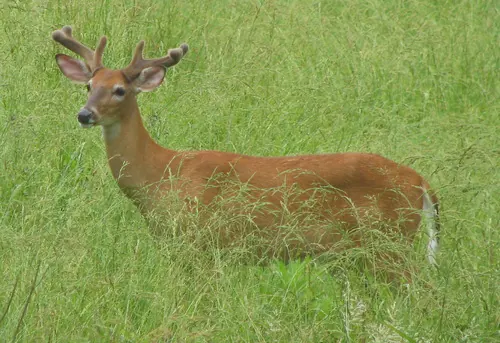
The white-tailed deer (Odocoileus virginianus), also known as the whitetail or Virginia deer, is a medium-sized deer native to the United States, Canada, Mexico, Central America, and South America as far south as Peru and Bolivia. It has also been introduced to New Zealand, Cuba, Jamaica, Hispaniola, Puerto Rico, Bahamas, Lesser Antilles, and some countries in Europe, such as Finland, the Czech Republic, and Serbia. In the Americas, it is the most widely distributed wild ungulate.
Summary adapted from Wikipedia via iNaturalist (CC BY-SA 4.0).
Field-craft tips#
- The autumn rut (Sept–Nov) brings bugling elk and sparring bucks.
- Keep 25 m+ from elk and moose; they are dangerous during the rut and calving.
- Use animal-eye AF; for herds stop down a little so several animals are sharp.
- Sightings peak in April, May, June, July, August and September, which is when you'll have the most chances.
Ethics#
- The welfare of the animal comes first: if it changes its behaviour because of you, you are too close.
- Stay on trails, respect closures around nests, leks, dens and haul-outs.
- Avoid playback and baiting in sensitive seasons; never bait predators.
- Don't share precise locations of rare, nesting or roosting animals publicly.
More Deer#
Frequently asked questions#
What lens do I need to photograph a White-tailed Deer?
At about 200 cm long, a white-tailed deer fills a third of a full-frame image at 10 m with roughly 59 mm, or at 20 m with 118 mm.
What shutter speed should I use for a White-tailed Deer?
1/500 s when it's still; 1/1600–1/2000 s for action.
When is the best time to photograph a White-tailed Deer?
Observations in North America peak in April, May, June, July, August and September. Early morning and late afternoon give the best light and activity.
Sources & licences#
- iNaturalist — Observation data CC BY-NC; photo licence as credited
- Wikipedia — CC BY-SA 4.0
Last updated October 03, 2026 · How we calculate · Sources