Recommended camera settings#
Focal length needed to frame it#
For a subject about 11 cm long filling a third or half of the frame width horizontally. Small birds demand long lenses and a close approach — a blind or feeder setup helps.
| Distance | ⅓ of frame (FF) | ½ of frame (FF) | ⅓ of frame (APS-C) | ⅓ of frame (MFT) |
|---|---|---|---|---|
| 5 m (16 ft) | 487 mm | 703 mm | 325 mm | 244 mm |
| 10 m (33 ft) | 975 mm | 1,406 mm | 650 mm | 487 mm |
| 15 m (49 ft) | 1,462 mm | 2,109 mm | 975 mm | 731 mm |
| 20 m (66 ft) | 1,949 mm | 2,812 mm | 1,300 mm | 975 mm |
| 30 m (98 ft) | 2,924 mm | 4,219 mm | 1,949 mm | 1,462 mm |
| 50 m (164 ft) | 4,874 mm | 7,031 mm | 3,249 mm | 2,437 mm |
About the Mexican Free-tailed Bat#
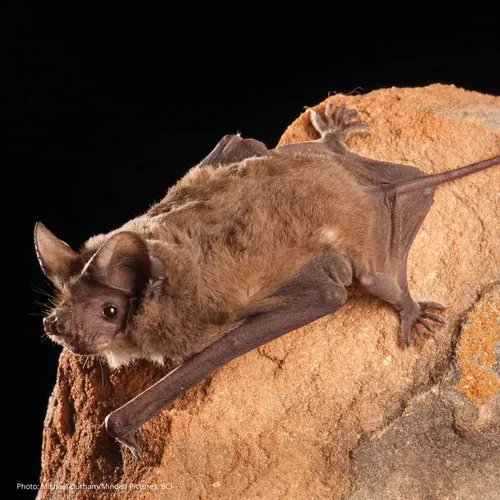
The Mexican free-tailed bat or Brazilian free-tailed bat (Tadarida brasiliensis) is a medium-sized bat native to the Americas, regarded as one of the most abundant mammals in North America. Its proclivity towards roosting in huge numbers at relatively few locations makes it vulnerable to habitat destruction in spite of its abundance. It has been claimed to have the fastest horizontal speed (as opposed to stoop diving speed) of any animal, reaching top ground speeds over 100 mph
Summary adapted from Wikipedia via iNaturalist (CC BY-SA 4.0).
Field-craft tips#
- Cave emergences at sunset (e.g. Texas) are a wide-angle spectacle.
- Bats need high-speed flash with an IR beam trigger; never photograph roosting bats in winter hibernation.
- Sightings peak in April and August, which is when you'll have the most chances.
- Tiny subjects: get close with a hide or feeder perch rather than cropping heavily.
Ethics#
- The welfare of the animal comes first: if it changes its behaviour because of you, you are too close.
- Stay on trails, respect closures around nests, leks, dens and haul-outs.
- Avoid playback and baiting in sensitive seasons; never bait predators.
- Don't share precise locations of rare, nesting or roosting animals publicly.
Frequently asked questions#
What lens do I need to photograph a Mexican Free-tailed Bat?
At about 11 cm long, a mexican free-tailed bat fills a third of a full-frame image at 10 m with roughly 975 mm, or at 20 m with 1,949 mm.
What shutter speed should I use for a Mexican Free-tailed Bat?
1/250 s when it's still; 1/20,000 s flash duration for action.
When is the best time to photograph a Mexican Free-tailed Bat?
Observations in North America peak in April and August. Early morning and late afternoon give the best light and activity.
Sources & licences#
- iNaturalist — Observation data CC BY-NC; photo licence as credited
- Wikipedia — CC BY-SA 4.0
Last updated October 03, 2026 · How we calculate · Sources