Recommended camera settings#
Focal length needed to frame it#
For a subject about 16 cm long filling a third or half of the frame width horizontally. Small birds demand long lenses and a close approach — a blind or feeder setup helps.
| Distance | ⅓ of frame (FF) | ½ of frame (FF) | ⅓ of frame (APS-C) | ⅓ of frame (MFT) |
|---|---|---|---|---|
| 5 m (16 ft) | 346 mm | 506 mm | 230 mm | 173 mm |
| 10 m (33 ft) | 691 mm | 1,011 mm | 461 mm | 346 mm |
| 15 m (49 ft) | 1,037 mm | 1,517 mm | 691 mm | 518 mm |
| 20 m (66 ft) | 1,382 mm | 2,022 mm | 922 mm | 691 mm |
| 30 m (98 ft) | 2,074 mm | 3,034 mm | 1,382 mm | 1,037 mm |
| 50 m (164 ft) | 3,456 mm | 5,056 mm | 2,304 mm | 1,728 mm |
About the Violet-green Swallow#
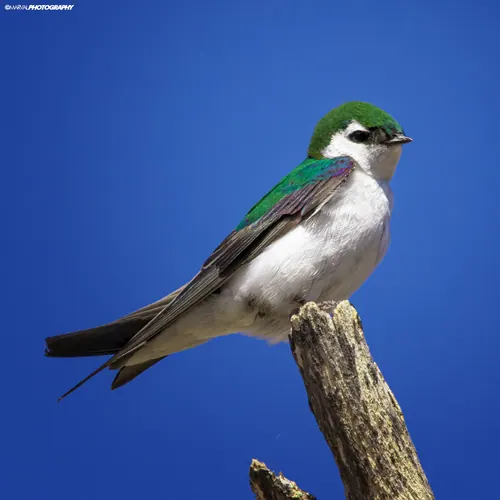
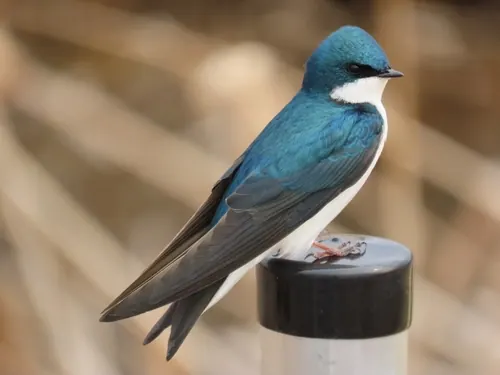
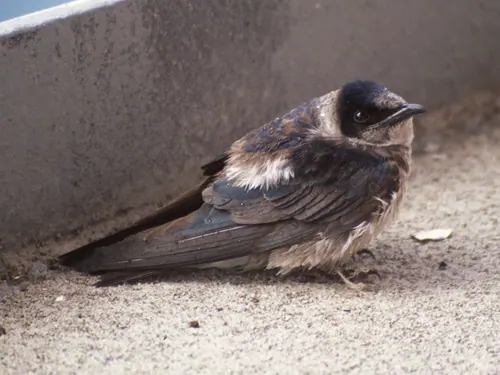
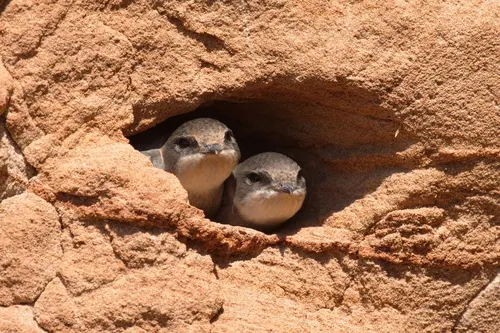
The violet-green swallow (Tachycineta thalassina) is a small North American passerine bird in the swallow family. These aerial insectivores are distributed along the west coast from Alaska to Mexico, extending as far east as Montana and Texas. With an appearance very similar to the tree swallow, these individuals can be identified by the white rump side-patches that appear to separate their green back and purple tail.
Summary adapted from Wikipedia via iNaturalist (CC BY-SA 4.0).
Field-craft tips#
- Photograph at nest sites or over water where they hunt insects.
- Swallows and swifts are the hardest flight subjects — use wide tracking AF and shoot where they repeat a pattern.
- Sightings peak in May and June, which is when you'll have the most chances.
Ethics#
- The welfare of the animal comes first: if it changes its behaviour because of you, you are too close.
- Stay on trails, respect closures around nests, leks, dens and haul-outs.
- Avoid playback and baiting in sensitive seasons; never bait predators.
- Don't share precise locations of rare, nesting or roosting animals publicly.
More Swallows and Martins#
Frequently asked questions#
What lens do I need to photograph a Violet-green Swallow?
At about 16 cm long, a violet-green swallow fills a third of a full-frame image at 10 m with roughly 691 mm, or at 20 m with 1,382 mm.
What shutter speed should I use for a Violet-green Swallow?
1/1600 s when it's still; 1/3200–1/4000 s for action.
When is the best time to photograph a Violet-green Swallow?
Observations in North America peak in May and June. Early morning and late afternoon give the best light and activity.
Sources & licences#
- iNaturalist — Observation data CC BY-NC; photo licence as credited
- Wikipedia — CC BY-SA 4.0
Last updated October 03, 2026 · How we calculate · Sources