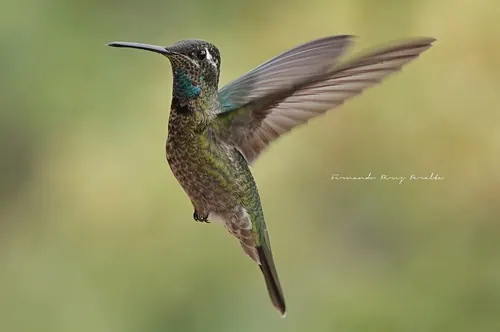
Recommended camera settings#
Focal length needed to frame it#
For a subject about 10 cm long filling a third or half of the frame width horizontally. Small birds demand long lenses and a close approach — a blind or feeder setup helps.
| Distance | ⅓ of frame (FF) | ½ of frame (FF) | ⅓ of frame (APS-C) | ⅓ of frame (MFT) |
|---|---|---|---|---|
| 5 m (16 ft) | 556 mm | 796 mm | 371 mm | 278 mm |
| 10 m (33 ft) | 1,112 mm | 1,593 mm | 741 mm | 556 mm |
| 15 m (49 ft) | 1,667 mm | 2,389 mm | 1,112 mm | 834 mm |
| 20 m (66 ft) | 2,223 mm | 3,186 mm | 1,482 mm | 1,112 mm |
| 30 m (98 ft) | 3,335 mm | 4,779 mm | 2,223 mm | 1,667 mm |
| 50 m (164 ft) | 5,558 mm | 7,965 mm | 3,705 mm | 2,779 mm |
About the Rivoli's Hummingbird#
Rivoli's hummingbird (Eugenes fulgens) is a large hummingbird. It was usually considered the only member of the genus Eugenes, and called magnificent hummingbird. Many taxonomic authorities, such as the International Ornithological Committee, split the northern, nominate subspecies E. f. fulgens from the larger, southern race of Costa Rica and Panama, E. f. spectabilis as distinct species, in which case the nominate fulgens is renamd Rivoli's hummingbird, and spectabilis is named the admirable hummingbird.
Summary adapted from Wikipedia via iNaturalist (CC BY-SA 4.0).
Field-craft tips#
- Feeders and nectar flowers create predictable perches.
- Iridescent gorgets only glow when the bird faces the light — angle yourself toward the sun.
- A 1.4× teleconverter and minimum focus distance matter more than the longest lens.
- Pre-focus on a favourite perch or feeder flower and wait; their wings beat 50–80 times a second.
- Sightings peak in May and August, which is when you'll have the most chances.
- Tiny subjects: get close with a hide or feeder perch rather than cropping heavily.
Ethics#
- The welfare of the animal comes first: if it changes its behaviour because of you, you are too close.
- Stay on trails, respect closures around nests, leks, dens and haul-outs.
- Avoid playback and baiting in sensitive seasons; never bait predators.
- Don't share precise locations of rare, nesting or roosting animals publicly.
More Hummingbirds#
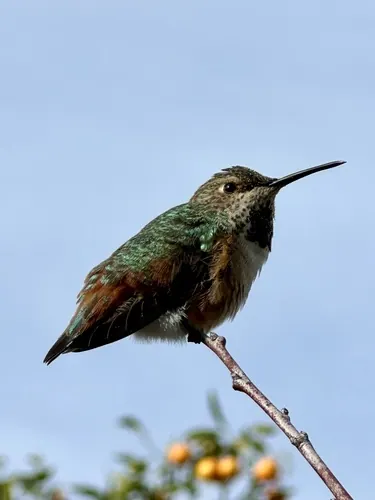 Allen's HummingbirdSelasphorus sasin
Rufous HummingbirdSelasphorus rufus
Allen's HummingbirdSelasphorus sasin
Rufous HummingbirdSelasphorus rufus
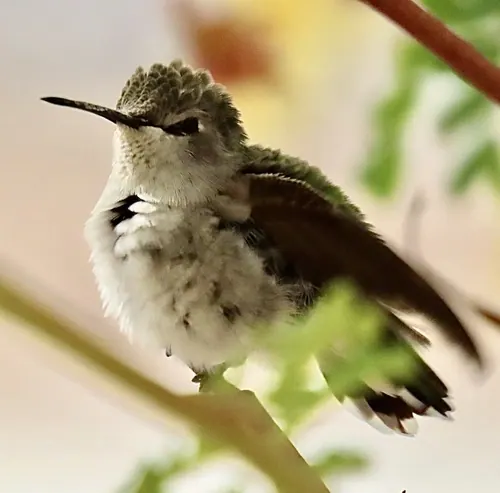 Costa's HummingbirdCalypte costae
Broad-tailed HummingbirdSelasphorus platycercus
Costa's HummingbirdCalypte costae
Broad-tailed HummingbirdSelasphorus platycercus
Frequently asked questions#
What lens do I need to photograph a Rivoli's Hummingbird?
At about 10 cm long, a rivoli's hummingbird fills a third of a full-frame image at 10 m with roughly 1,112 mm, or at 20 m with 2,223 mm.
What shutter speed should I use for a Rivoli's Hummingbird?
1/1000 s when it's still; 1/4000 s+ (or 1/250 s with multi-flash to freeze wings) for action.
When is the best time to photograph a Rivoli's Hummingbird?
Observations in North America peak in May and August. Early morning and late afternoon give the best light and activity.
Sources & licences#
- iNaturalist — Observation data CC BY-NC; photo licence as credited
- Wikipedia — CC BY-SA 4.0
Last updated October 03, 2026 · How we calculate · Sources