Recommended camera settings#
Focal length needed to frame it#
For a subject about 32 cm long filling a third or half of the frame width horizontally.
| Distance | ⅓ of frame (FF) | ½ of frame (FF) | ⅓ of frame (APS-C) | ⅓ of frame (MFT) |
|---|---|---|---|---|
| 5 m (16 ft) | 176 mm | 262 mm | 118 mm | 88 mm |
| 10 m (33 ft) | 353 mm | 525 mm | 235 mm | 176 mm |
| 15 m (49 ft) | 529 mm | 787 mm | 353 mm | 264 mm |
| 20 m (66 ft) | 705 mm | 1,050 mm | 470 mm | 353 mm |
| 30 m (98 ft) | 1,058 mm | 1,574 mm | 705 mm | 529 mm |
| 50 m (164 ft) | 1,763 mm | 2,624 mm | 1,175 mm | 882 mm |
About the Northern Flicker#
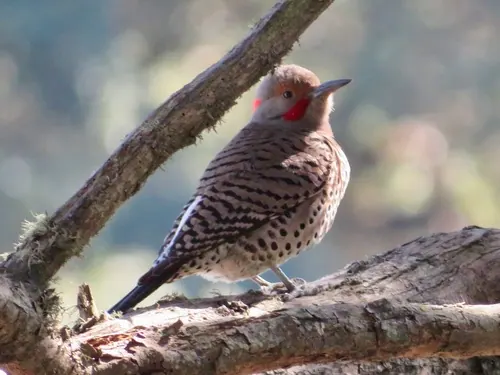
The northern flicker (Colaptes auratus) is a medium-sized bird of the woodpecker family. It is native to most of North America, parts of Central America, Cuba, and the Cayman Islands, and is one of the few woodpecker species that migrate. Over 100 common names for the northern flicker are known, including yellowhammer (not to be confused with the Eurasian yellowhammer), clape, gaffer woodpecker, harry-wicket, heigh-ho, wake-up, walk-up, wick-up, yarrup, and gawker bird.
Summary adapted from Wikipedia via iNaturalist (CC BY-SA 4.0).
Field-craft tips#
- Dead snags are favourite drumming posts.
- Expose for the bright head patches; forests are dim, so raise ISO before dropping shutter speed.
- Trunk-clinging birds sit in shade: watch your shutter speed and use zone AF to avoid focusing on bark.
- Sightings peak in April, which is when you'll have the most chances.
Ethics#
- The welfare of the animal comes first: if it changes its behaviour because of you, you are too close.
- Stay on trails, respect closures around nests, leks, dens and haul-outs.
- Avoid playback and baiting in sensitive seasons; never bait predators.
- Don't share precise locations of rare, nesting or roosting animals publicly.
More Woodpeckers#
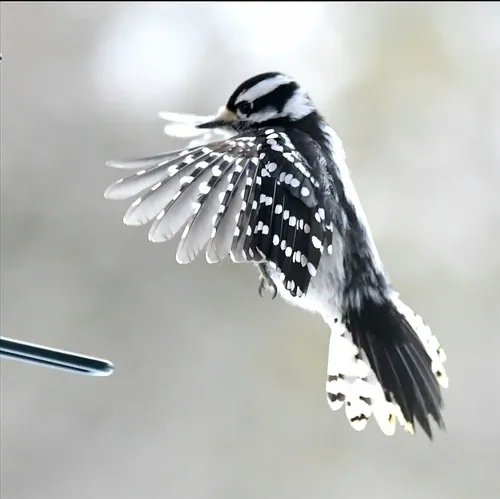 Downy WoodpeckerDryobates pubescens
Red-bellied WoodpeckerMelanerpes carolinus
Downy WoodpeckerDryobates pubescens
Red-bellied WoodpeckerMelanerpes carolinus
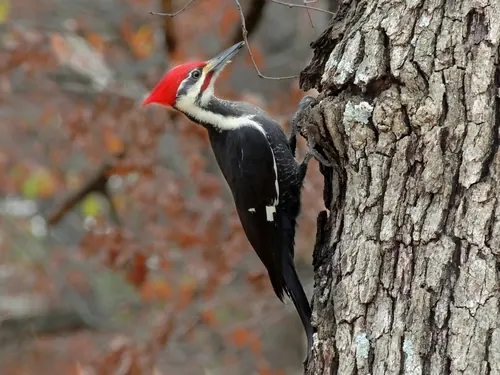 Pileated WoodpeckerDryocopus pileatus
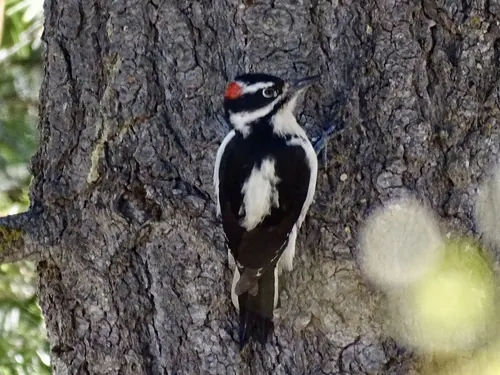 Hairy WoodpeckerLeuconotopicus villosus
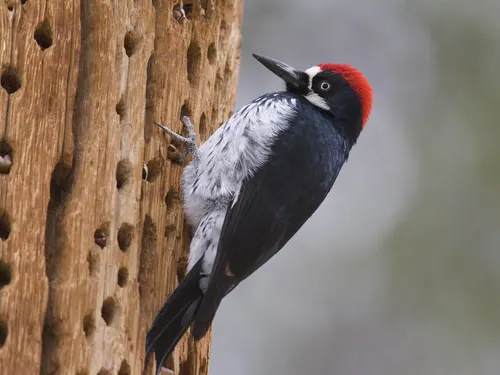 Acorn WoodpeckerMelanerpes formicivorus
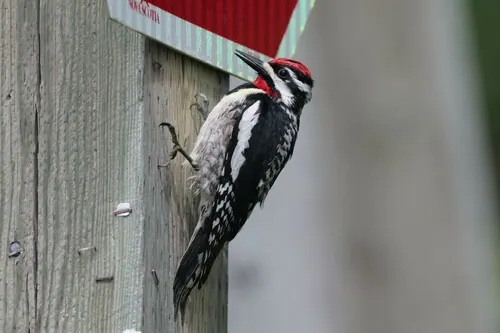 Yellow-bellied SapsuckerSphyrapicus varius
Golden-fronted WoodpeckerMelanerpes aurifrons
Red-headed WoodpeckerMelanerpes erythrocephalus
Yellow-bellied SapsuckerSphyrapicus varius
Golden-fronted WoodpeckerMelanerpes aurifrons
Red-headed WoodpeckerMelanerpes erythrocephalus
Frequently asked questions#
What lens do I need to photograph a Northern Flicker?
At about 32 cm long, a northern flicker fills a third of a full-frame image at 10 m with roughly 353 mm, or at 20 m with 705 mm.
What shutter speed should I use for a Northern Flicker?
1/800 s when it's still; 1/2500 s for action.
When is the best time to photograph a Northern Flicker?
Observations in North America peak in April. Early morning and late afternoon give the best light and activity.
Sources & licences#
- iNaturalist — Observation data CC BY-NC; photo licence as credited
- Wikipedia — CC BY-SA 4.0
Last updated October 03, 2026 · How we calculate · Sources