Recommended camera settings#
Focal length needed to frame it#
For a subject about 95 cm long filling a third or half of the frame width horizontally.
| Distance | ⅓ of frame (FF) | ½ of frame (FF) | ⅓ of frame (APS-C) | ⅓ of frame (MFT) |
|---|---|---|---|---|
| 5 m (16 ft) | 62 mm | 93 mm | 41 mm | 31 mm |
| 10 m (33 ft) | 124 mm | 186 mm | 82 mm | 62 mm |
| 15 m (49 ft) | 185 mm | 279 mm | 124 mm | 93 mm |
| 20 m (66 ft) | 247 mm | 372 mm | 165 mm | 124 mm |
| 30 m (98 ft) | 371 mm | 558 mm | 247 mm | 185 mm |
| 50 m (164 ft) | 618 mm | 930 mm | 412 mm | 309 mm |
About the Muscovy Duck#
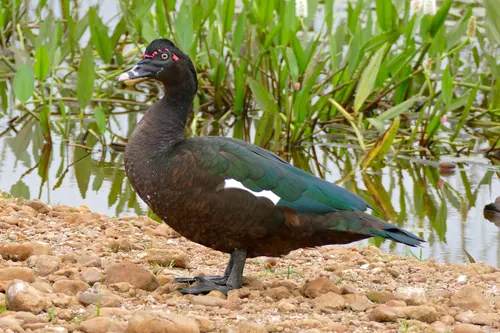
The Muscovy duck (Cairina moschata) is a large duck native to Mexico and Central and South America. Small wild and feral breeding populations have established themselves in the United States, particularly in Florida, Louisiana, Massachusetts, and the lower Rio Grande Valley of Texas as well as in many other parts of North America, including southern Canada. Feral Muscovy ducks are found in New Zealand, Australia, and in parts of Europe.
Summary adapted from Wikipedia via iNaturalist (CC BY-SA 4.0).
Field-craft tips#
- Winter is peak season for colourful drakes.
- Morning side-light reveals iridescent head colours.
- Get low to the water for an eye-level perspective; expose for bright plumage to avoid clipped whites.
- Sightings peak in March and April, which is when you'll have the most chances.
Ethics#
- The welfare of the animal comes first: if it changes its behaviour because of you, you are too close.
- Stay on trails, respect closures around nests, leks, dens and haul-outs.
- Avoid playback and baiting in sensitive seasons; never bait predators.
- Don't share precise locations of rare, nesting or roosting animals publicly.
More Ducks, Geese, and Swans#
Frequently asked questions#
What lens do I need to photograph a Muscovy Duck?
At about 95 cm long, a muscovy duck fills a third of a full-frame image at 10 m with roughly 124 mm, or at 20 m with 247 mm.
What shutter speed should I use for a Muscovy Duck?
1/640 s when it's still; 1/2000–1/3200 s for action.
When is the best time to photograph a Muscovy Duck?
Observations in North America peak in March and April. Early morning and late afternoon give the best light and activity.
Sources & licences#
- iNaturalist — Observation data CC BY-NC; photo licence as credited
- Wikipedia — CC BY-SA 4.0
Last updated October 03, 2026 · How we calculate · Sources