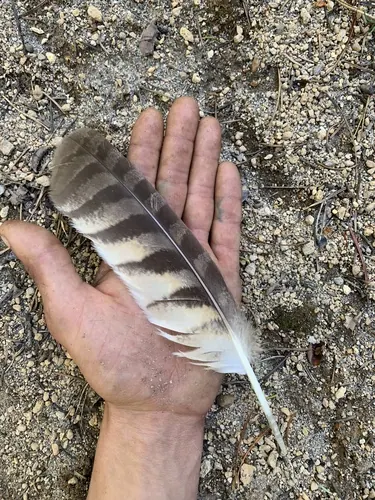
Recommended camera settings#
Focal length needed to frame it#
For a subject about 44 cm long filling a third or half of the frame width horizontally.
| Distance | ⅓ of frame (FF) | ½ of frame (FF) | ⅓ of frame (APS-C) | ⅓ of frame (MFT) |
|---|---|---|---|---|
| 5 m (16 ft) | 133 mm | 199 mm | 89 mm | 66 mm |
| 10 m (33 ft) | 266 mm | 397 mm | 177 mm | 133 mm |
| 15 m (49 ft) | 399 mm | 596 mm | 266 mm | 199 mm |
| 20 m (66 ft) | 532 mm | 795 mm | 354 mm | 266 mm |
| 30 m (98 ft) | 798 mm | 1,192 mm | 532 mm | 399 mm |
| 50 m (164 ft) | 1,329 mm | 1,987 mm | 886 mm | 665 mm |
About the Great Horned Owl#
The great horned owl (Bubo virginianus), also known as the tiger owl (originally derived from early naturalists' description as the "winged tiger" or "tiger of the air") or the hoot owl, is a large owl native to the Americas. It is an extremely adaptable bird with a vast range and is the most widely distributed true owl in the Americas. Its primary diet is rabbits and hares, rats and mice and voles, although it freely hunts...
Summary adapted from Wikipedia via iNaturalist (CC BY-SA 4.0).
Field-craft tips#
- Never bait or call owls excessively; stay on trails.
- A long lens (500 mm+) keeps a respectful distance.
- Mostly crepuscular: lean on a fast lens, high ISO and stabilisation; keep distance and avoid flash at nests.
- Sightings peak in April and May, which is when you'll have the most chances.
Ethics#
- The welfare of the animal comes first: if it changes its behaviour because of you, you are too close.
- Stay on trails, respect closures around nests, leks, dens and haul-outs.
- Avoid playback and baiting in sensitive seasons; never bait predators.
- Don't share precise locations of rare, nesting or roosting animals publicly.
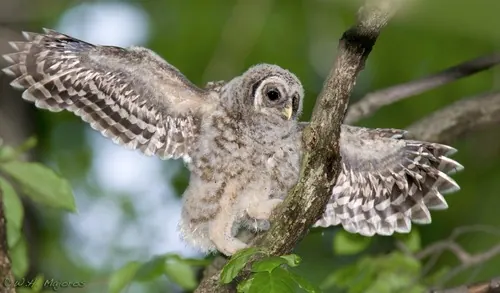
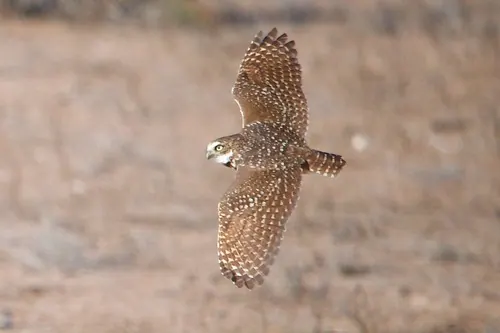
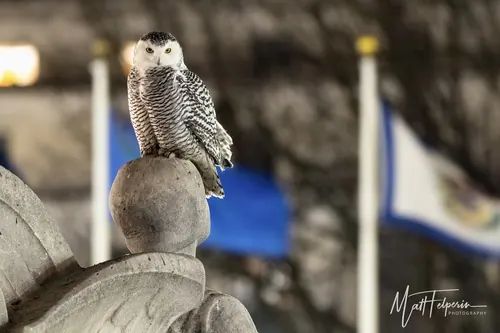
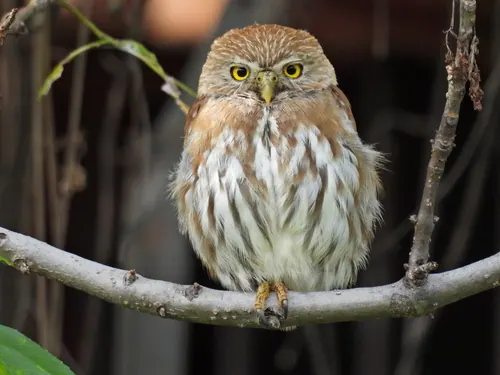
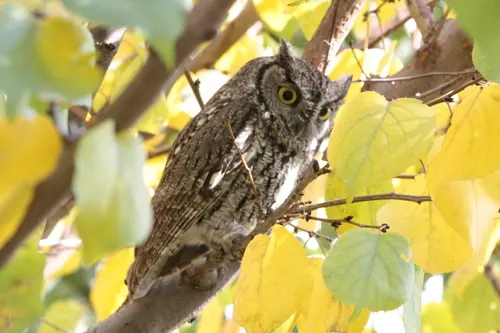
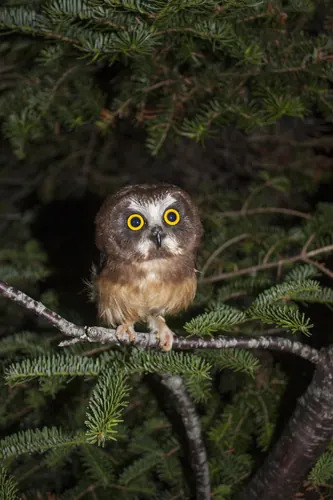
More Typical Owls#
Frequently asked questions#
What lens do I need to photograph a Great Horned Owl?
At about 44 cm long, a great horned owl fills a third of a full-frame image at 10 m with roughly 266 mm, or at 20 m with 532 mm.
What shutter speed should I use for a Great Horned Owl?
1/250–1/500 s when it's still; 1/2000 s for action.
When is the best time to photograph a Great Horned Owl?
Observations in North America peak in April and May. Early morning and late afternoon give the best light and activity.
Sources & licences#
- iNaturalist — Observation data CC BY-NC; photo licence as credited
- Wikipedia — CC BY-SA 4.0
Last updated October 03, 2026 · How we calculate · Sources