Recommended camera settings#
Focal length needed to frame it#
For a subject about 18 cm long filling a third or half of the frame width horizontally. Small birds demand long lenses and a close approach — a blind or feeder setup helps.
| Distance | ⅓ of frame (FF) | ½ of frame (FF) | ⅓ of frame (APS-C) | ⅓ of frame (MFT) |
|---|---|---|---|---|
| 5 m (16 ft) | 302 mm | 443 mm | 201 mm | 151 mm |
| 10 m (33 ft) | 603 mm | 887 mm | 402 mm | 302 mm |
| 15 m (49 ft) | 905 mm | 1,330 mm | 603 mm | 453 mm |
| 20 m (66 ft) | 1,207 mm | 1,773 mm | 805 mm | 603 mm |
| 30 m (98 ft) | 1,810 mm | 2,660 mm | 1,207 mm | 905 mm |
| 50 m (164 ft) | 3,017 mm | 4,433 mm | 2,011 mm | 1,509 mm |
About the Gray Kingbird#
The gray kingbird or grey kingbird, also known as pitirre, petchary, or white-breasted kingbird (Tyrannus dominicensis) is a passerine bird. It breeds from the extreme southeast of the United States, mainly in Florida, through Central America, from Cuba to Puerto Rico as well as eastward towards all across the Lesser West Indies, south to Venezuela, Trinidad, Tobago, the Guiana, and Colombia. Northern populations are migratory, wintering on the Caribbean coast of Central America and northern South...
Summary adapted from Wikipedia via iNaturalist (CC BY-SA 4.0).
Field-craft tips#
- They return to the same hunting perch — pre-focus and wait.
- Bird-eye AF with continuous focus (AF-C/AI Servo); fill at least a third of the frame.
- Sightings peak in April, May and July, which is when you'll have the most chances.
Ethics#
- The welfare of the animal comes first: if it changes its behaviour because of you, you are too close.
- Stay on trails, respect closures around nests, leks, dens and haul-outs.
- Avoid playback and baiting in sensitive seasons; never bait predators.
- Don't share precise locations of rare, nesting or roosting animals publicly.
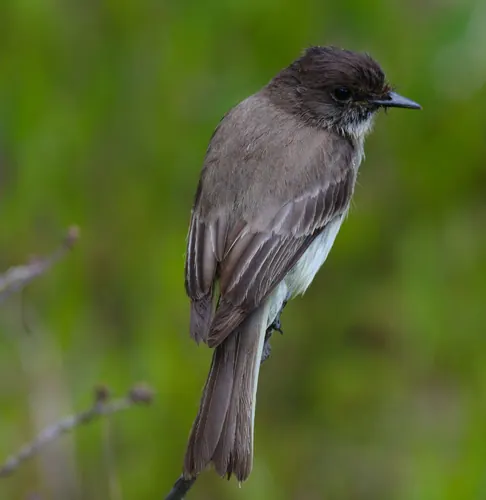
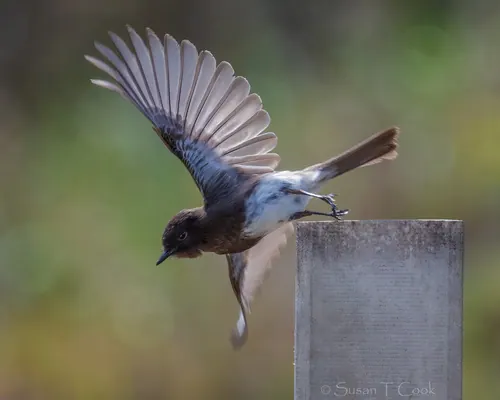
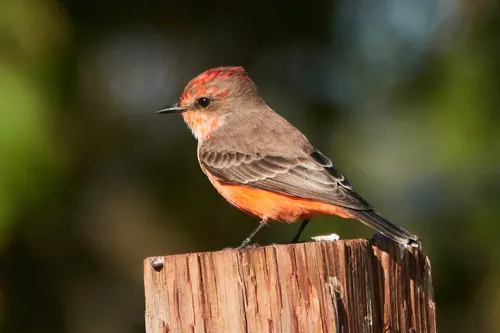
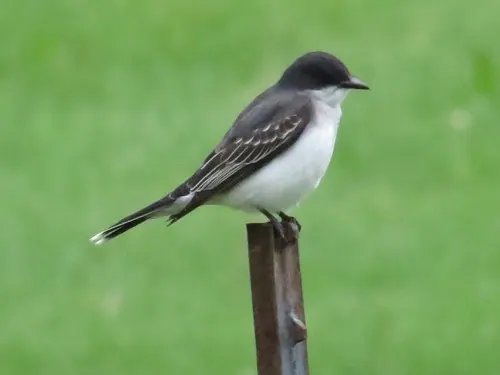
More Tyrant Flycatchers#
Frequently asked questions#
What lens do I need to photograph a Gray Kingbird?
At about 18 cm long, a gray kingbird fills a third of a full-frame image at 10 m with roughly 603 mm, or at 20 m with 1,207 mm.
What shutter speed should I use for a Gray Kingbird?
1/800 s when it's still; 1/2500–1/3200 s for action.
When is the best time to photograph a Gray Kingbird?
Observations in North America peak in April, May and July. Early morning and late afternoon give the best light and activity.
Sources & licences#
- iNaturalist — Observation data CC BY-NC; photo licence as credited
- Wikipedia — CC BY-SA 4.0
Last updated October 03, 2026 · How we calculate · Sources