Recommended camera settings#
Focal length needed to frame it#
For a subject about 17 cm long filling a third or half of the frame width horizontally. Small birds demand long lenses and a close approach — a blind or feeder setup helps.
| Distance | ⅓ of frame (FF) | ½ of frame (FF) | ⅓ of frame (APS-C) | ⅓ of frame (MFT) |
|---|---|---|---|---|
| 5 m (16 ft) | 327 mm | 479 mm | 218 mm | 163 mm |
| 10 m (33 ft) | 653 mm | 957 mm | 435 mm | 327 mm |
| 15 m (49 ft) | 980 mm | 1,436 mm | 653 mm | 490 mm |
| 20 m (66 ft) | 1,306 mm | 1,915 mm | 871 mm | 653 mm |
| 30 m (98 ft) | 1,960 mm | 2,872 mm | 1,306 mm | 980 mm |
| 50 m (164 ft) | 3,266 mm | 4,787 mm | 2,177 mm | 1,633 mm |
About the American Dipper#
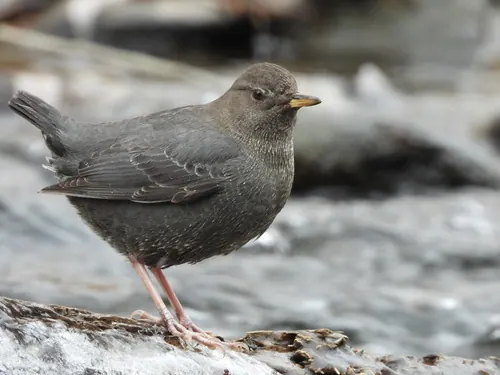
The American dipper (Cinclus mexicanus), also known as a water ouzel, is a stocky dark grey bird with a head sometimes tinged with brown, and white feathers on the eyelids that cause the eyes to flash white as the bird blinks. It is 16.5 cm long and weighs on average 46 g. It has long legs, and bobs its whole body up and down during pauses as it feeds on the bottom of fast-moving, rocky streams.
Summary adapted from Wikipedia via iNaturalist (CC BY-SA 4.0).
Field-craft tips#
- Fast streams: 1/1000 s freezes splashes, 1/15 s silks the water.
- Bird-eye AF with continuous focus (AF-C/AI Servo); fill at least a third of the frame.
- Sightings peak in June, July, August and September, which is when you'll have the most chances.
Ethics#
- The welfare of the animal comes first: if it changes its behaviour because of you, you are too close.
- Stay on trails, respect closures around nests, leks, dens and haul-outs.
- Avoid playback and baiting in sensitive seasons; never bait predators.
- Don't share precise locations of rare, nesting or roosting animals publicly.
Frequently asked questions#
What lens do I need to photograph an American Dipper?
At about 17 cm long, an american dipper fills a third of a full-frame image at 10 m with roughly 653 mm, or at 20 m with 1,306 mm.
What shutter speed should I use for an American Dipper?
1/800 s when it's still; 1/2500–1/3200 s for action.
When is the best time to photograph a American Dipper?
Observations in North America peak in June, July, August and September. Early morning and late afternoon give the best light and activity.
Sources & licences#
- iNaturalist — Observation data CC BY-NC; photo licence as credited
- Wikipedia — CC BY-SA 4.0
Last updated October 03, 2026 · How we calculate · Sources