Recommended camera settings#
Focal length needed to frame it#
For a subject about 35 cm long filling a third or half of the frame width horizontally.
| Distance | ⅓ of frame (FF) | ½ of frame (FF) | ⅓ of frame (APS-C) | ⅓ of frame (MFT) |
|---|---|---|---|---|
| 5 m (16 ft) | 164 mm | 245 mm | 109 mm | 82 mm |
| 10 m (33 ft) | 328 mm | 489 mm | 219 mm | 164 mm |
| 15 m (49 ft) | 492 mm | 734 mm | 328 mm | 246 mm |
| 20 m (66 ft) | 657 mm | 978 mm | 438 mm | 328 mm |
| 30 m (98 ft) | 985 mm | 1,467 mm | 657 mm | 492 mm |
| 50 m (164 ft) | 1,641 mm | 2,446 mm | 1,094 mm | 821 mm |
About the American Coot#
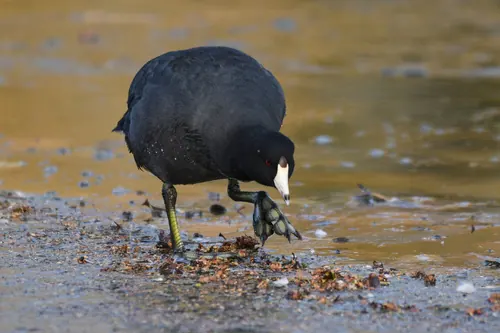
The American coot (Fulica americana), also known as a mud hen, is a bird of the family Rallidae. Though commonly mistaken to be ducks, American coots belong to a distinct order. Unlike the webbed feet of ducks, coots have broad, lobed scales on their lower legs and toes that fold back with each step in order to facilitate walking on dry land.
Summary adapted from Wikipedia via iNaturalist (CC BY-SA 4.0).
Field-craft tips#
- Rails skulk in reeds — wait at a gap in the vegetation at dawn.
- Shoot from ground level; game birds flush suddenly, so keep the shutter fast and AF in continuous mode.
- Sightings peak in January, February, March, April, November and December, which is when you'll have the most chances.
Ethics#
- The welfare of the animal comes first: if it changes its behaviour because of you, you are too close.
- Stay on trails, respect closures around nests, leks, dens and haul-outs.
- Avoid playback and baiting in sensitive seasons; never bait predators.
- Don't share precise locations of rare, nesting or roosting animals publicly.
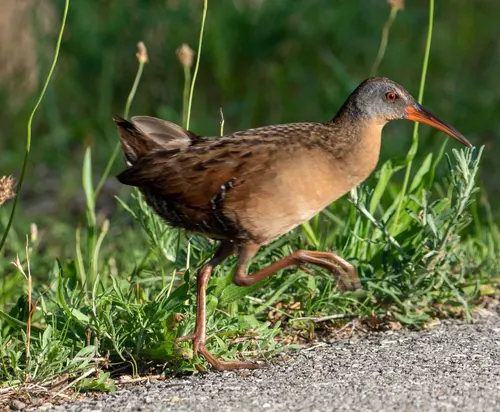
More Rails, Gallinules, and Coots#
Frequently asked questions#
What lens do I need to photograph an American Coot?
At about 35 cm long, an american coot fills a third of a full-frame image at 10 m with roughly 328 mm, or at 20 m with 657 mm.
What shutter speed should I use for an American Coot?
1/500 s when it's still; 1/2000 s for action.
When is the best time to photograph a American Coot?
Observations in North America peak in January, February, March, April, November and December. Early morning and late afternoon give the best light and activity.
Sources & licences#
- iNaturalist — Observation data CC BY-NC; photo licence as credited
- Wikipedia — CC BY-SA 4.0
Last updated October 03, 2026 · How we calculate · Sources