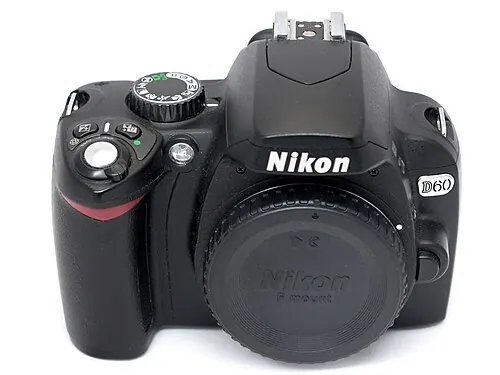
Specifications#
- Brand
- Nikon
- Model
- D60
- Camera type
- DSLR
- Released
- 2008-01-01
- Lens mount
- Nikon F
- Sensor size
- 23.6 × 15.8 mm (APS-C)
- Crop factor
- 1.52×
- Resolution
- 10 MP (3,872 × 2,592 px)
- ISO range
- 100 – 1,600
- Continuous shooting
- 3 fps
- Weight
- 495 g (17.5 oz)
- Sensor
- 23.6 × 15.8 mm Nikon DX format RGB CCD sensor, 1.5 × FOV crop
- Storage
- Secure Digital and Secure Digital High Capacity (max. 32GB)
- Viewfinder
- Optical TTL
- AF points / area
- 3 zone selectable: single area, dynamic area, closest subject
- Metering
- TTL full-aperture exposure metering system
- Exposure modes
- Automatic (Portrait, Landscape, Child, Sport, Closeup, Night Portrait, Aperture Priority, Shutter Priority, Programmed Auto, Stop Motion) and Manual Mode
- Shutter
- Combined mechanical and CCD electronic shutter
- Flash
- Built-in TTL Speedlight with hotshoe (e.g. for the matching SB-400 Speedlight)
- Battery
- Nikon EN-EL family
- Lens
- Interchangeable Nikon F-mount
- Predecessor
- Nikon D40x
- Drive
- 3 frame/s
Specifications merged from Wikipedia, Wikidata, Lensfun and openMVG. Spot an error? Tell us.
Sensor size compared#
Focal length equivalents & field of view#
Multiply any focal length by 1.52 to get the full-frame field of view. Angles are for a rectilinear lens focused at infinity.
| Lens on this camera | Full-frame equivalent | Horizontal | Vertical | Diagonal |
|---|---|---|---|---|
| 8 mm | 12 mm | 111.7° | 89.3° | 121.2° |
| 10 mm | 15 mm | 99.4° | 76.6° | 109.7° |
| 12 mm | 18 mm | 89.0° | 66.7° | 99.6° |
| 14 mm | 21 mm | 80.3° | 58.9° | 90.8° |
| 16 mm | 24 mm | 72.8° | 52.6° | 83.2° |
| 18 mm | 27 mm | 66.5° | 47.4° | 76.5° |
| 20 mm | 30 mm | 61.1° | 43.1° | 70.8° |
| 24 mm | 37 mm | 52.4° | 36.4° | 61.2° |
| 28 mm | 43 mm | 45.7° | 31.5° | 53.8° |
| 35 mm | 53 mm | 37.3° | 25.4° | 44.2° |
| 40 mm | 61 mm | 32.9° | 22.3° | 39.1° |
| 50 mm | 76 mm | 26.6° | 18.0° | 31.7° |
| 56 mm | 85 mm | 23.8° | 16.1° | 28.5° |
| 70 mm | 107 mm | 19.1° | 12.9° | 22.9° |
| 85 mm | 129 mm | 15.8° | 10.6° | 19.0° |
| 100 mm | 152 mm | 13.5° | 9.0° | 16.2° |
| 135 mm | 206 mm | 10.0° | 6.7° | 12.0° |
| 200 mm | 305 mm | 6.8° | 4.5° | 8.1° |
| 300 mm | 457 mm | 4.5° | 3.0° | 5.4° |
| 400 mm | 609 mm | 3.4° | 2.3° | 4.1° |
| 600 mm | 914 mm | 2.3° | 1.5° | 2.7° |
| 800 mm | 1219 mm | 1.7° | 1.1° | 2.0° |
Depth of field table#
Total depth of field at each subject distance, using a circle of confusion of 19.7 µm (the 0.030 mm full-frame standard scaled by the crop factor). Detailed tables: 24 mm f/1.8, 24 mm f/2.8, 35 mm f/1.8, 35 mm f/2.8, 50 mm f/1.8, 50 mm f/2.8.
| Focal | Aperture | 50.0 cm | 1.00 m | 2.00 m | 3.00 m | 5.00 m | 10.0 m | Hyperfocal |
|---|---|---|---|---|---|---|---|---|
| 14 mm | f/1.8 | 8.9 cm | 36.8 cm | 1.65 m | 4.57 m | 48.2 m | ∞ | 5.54 m |
| 14 mm | f/2.8 | 13.9 cm | 60.1 cm | 3.25 m | 17.1 m | ∞ | ∞ | 3.57 m |
| 14 mm | f/4 | 20.3 cm | 94.0 cm | 8.80 m | ∞ | ∞ | ∞ | 2.50 m |
| 14 mm | f/8 | 46.1 cm | 4.26 m | ∞ | ∞ | ∞ | ∞ | 1.26 m |
| 28 mm | f/1.8 | 2.1 cm | 8.8 cm | 35.9 cm | 82.1 cm | 2.37 m | 11.3 m | 22.1 m |
| 28 mm | f/2.8 | 3.3 cm | 13.7 cm | 56.6 cm | 1.31 m | 3.98 m | 27.6 m | 14.2 m |
| 28 mm | f/4 | 4.8 cm | 19.7 cm | 82.5 cm | 1.97 m | 6.66 m | ∞ | 9.98 m |
| 28 mm | f/8 | 9.6 cm | 40.6 cm | 1.88 m | 5.57 m | 5.5 km | ∞ | 5.00 m |
| 48 mm | f/1.8 | 0.7 cm | 2.9 cm | 12.0 cm | 27.3 cm | 76.6 cm | 3.14 m | 65.0 m |
| 48 mm | f/2.8 | 1.1 cm | 4.6 cm | 18.7 cm | 42.6 cm | 1.20 m | 5.05 m | 41.8 m |
| 48 mm | f/4 | 1.5 cm | 6.5 cm | 26.8 cm | 61.2 cm | 1.74 m | 7.70 m | 29.3 m |
| 48 mm | f/8 | 3.1 cm | 13.1 cm | 54.4 cm | 1.26 m | 3.82 m | 25.3 m | 14.7 m |
| 78 mm | f/1.8 | 0.2 cm | 1.1 cm | 4.5 cm | 10.2 cm | 28.7 cm | 1.16 m | 172 m |
| 78 mm | f/2.8 | 0.4 cm | 1.7 cm | 7.0 cm | 15.9 cm | 44.7 cm | 1.81 m | 110 m |
| 78 mm | f/4 | 0.5 cm | 2.4 cm | 10.0 cm | 22.7 cm | 64.0 cm | 2.61 m | 77.3 m |
| 78 mm | f/8 | 1.1 cm | 4.8 cm | 20.0 cm | 45.7 cm | 1.30 m | 5.50 m | 38.7 m |
Equivalent aperture#
Exposure is identical at the same f-number on any format; equivalence only describes depth of field and total light.
Diffraction & pixel pitch#
With 6.10 µm pixels, diffraction starts to soften pixel-level detail around f/9.1. For maximum sharpness keep landscapes between f/5.0 and f/9; stopping down further trades detail for depth of field.
| Aperture | Airy disk diameter | Spread over | At 100% view |
|---|---|---|---|
| f/2.8 | 3.8 µm | 0.6 px | sharp |
| f/4 | 5.4 µm | 0.9 px | sharp |
| f/5.6 | 7.5 µm | 1.2 px | sharp |
| f/8 | 10.7 µm | 1.8 px | sharp |
| f/11 | 14.8 µm | 2.4 px | slight softening |
| f/16 | 21.5 µm | 3.5 px | visibly soft |
| f/22 | 29.5 µm | 4.8 px | visibly soft |
Maximum print sizes#
At 10 MP the Nikon D60 produces 3,872 × 2,592 pixel images. See the 10 megapixel guide or the print size calculator.
| Resolution | Typical use | Inches | Centimetres |
|---|---|---|---|
| 300 DPI | Photo-lab quality | 12.9 × 8.6 in | 33 × 22 cm |
| 240 DPI | Fine-art inkjet | 16.1 × 10.8 in | 41 × 27 cm |
| 200 DPI | Wall print | 19.4 × 13.0 in | 49 × 33 cm |
| 150 DPI | Poster, viewed from 1 m+ | 25.8 × 17.3 in | 66 × 44 cm |
Night-sky exposure limits#
Longest exposure before stars trail. The NPF rule accounts for pixel pitch and is stricter than the classic 500 rule — use it for pin-sharp stars on high-resolution sensors.
| Focal length | 500 rule | NPF f/1.8 | NPF f/2.8 | NPF f/4 |
|---|---|---|---|---|
| 9 mm (14 mm eq.) | 36.5 s | 27.3 s | 31.2 s | 35.9 s |
| 13 mm (20 mm eq.) | 25.2 s | 18.9 s | 21.6 s | 24.8 s |
| 16 mm (24 mm eq.) | 20.5 s | 15.4 s | 17.6 s | 20.2 s |
| 23 mm (35 mm eq.) | 14.3 s | 10.7 s | 12.2 s | 14.0 s |
| 33 mm (50 mm eq.) | 9.9 s | 7.5 s | 8.5 s | 9.8 s |
Handheld shutter speed guide#
The reciprocal rule uses the equivalent focal length. High-resolution sensors may need one stop faster than this for pixel-sharp results.
| Focal length | No stabilisation (1/equiv. focal) | With 3-stop IS | With 5-stop IBIS |
|---|---|---|---|
| 16 mm | 1/25 s | 0.3 s | 1.3 s |
| 33 mm | 1/50 s | 1/6 s | 0.6 s |
| 66 mm | 1/100 s | 1/13 s | 0.3 s |
| 131 mm | 1/200 s | 1/25 s | 1/6 s |
Lenses for the Nikon D60#
Native Nikon F lenses in our database (319 total). Also adaptable: T-mount (T2), M42 screw mount, Deckel (DKL), Tamron Adaptall, M39 / LTM (Leica thread).
- Samyang 8mm f/3.5 Fish-Eye CS 8 mm
- Samyang 10mm f/2.8 ED AS NCS CS 10 mm
- Laowa 12mm f/2.8 Zero-D 12 mm
- Samyang 12mm f/2.8 Fish-Eye ED AS NCS 12 mm
- Samyang 14mm f/2.8 AE ED AS IF UMC 14 mm
- Samyang AF 14mm f/2.8 14 mm
- Sigma 14mm f/1.8 DG HSM | A 14 mm
- Laowa 15mm F/4 Wide Angle Macro 15 mm
- Samyang 16mm f/2.0 ED AS UMC CS 16 mm
- Samyang 20mm f/1.8 ED AS UMC 20 mm
- Samyang 24mm f/1.4 ED AS IF UMC 24 mm
- Samyang T-S 24mm f/3.5 ED AS UMC 24 mm
- Sigma 24mm f/1.4 DG HSM | A 24 mm
- Sigma 28mm F1.4 DG HSM | Art 28 mm
- Sigma 40mm F1.4 DG HSM | Art 40 mm
- Laowa 60mm f/2.8 2X Ultra-Macro 60 mm
- Sigma 70-200mm F2.8 DG OS HSM | S 70–200 mm
- Samyang 85mm f/1.4 IF UMC Aspherical 85 mm
- Sigma 100-400mm F5-6.3 DG OS HSM | C 100–400 mm
- Sigma 100-400mm f/5-6.3 DG OS HSM | C +1.4x ext. 100–400 mm
- Sigma 105 mm F1.4 DG HSM Art 105 mm
- Samyang 135mm f/2 ED UMC 135 mm
- Sigma 4.5mm f/2.8 EX DC HSM circular fisheye 4.5 mm
- Nikon Nikkor AI-S 6mm f/2.8 Fisheye 6 mm
- Sigma 8-16mm f/4.5-5.6 DC HSM 8–16 mm
- Sigma 8mm f/3.5 EX DG circular fisheye 8 mm
- Nikon Nikkor AF-P 10-20mm f/4.5-5.6G DX VR 10–20 mm
- Nikon Nikkor AF-S 10-24mm f/3.5-4.5G DX ED 10–24 mm
- Sigma 10-20mm f/3.5 EX DC HSM 10–20 mm
- Sigma 10-20mm f/4-5.6 EX DC 10–20 mm
- Sigma 10mm f/2.8 EX DC Fisheye HSM 10 mm
- Tamron 10-24mm f/3.5-4.5 Di II VC HLD 10–24 mm
- Tamron SP AF 10-24mm f/3.5-4.5 Di II LD Aspherical (IF) 10–24 mm
- Nikon Nikkor AF 10.5mm f/2.8G DX ED Fisheye 10.5 mm
- Tamron SP AF 11-18mm f/4.5-5.6 Di-II LD Aspherical (IF) 11–18 mm
- Tokina AF 11-16mm f/2.8 AT-X Pro DX 11–16 mm
Similar cameras#
Other APS-C cameras from around the same time.
- Pentax K-5 2010
- Pentax K110D 2006
- Sony Alpha 200 2008
- Sony Alpha 350 2008
- Sony Alpha 230 2009
- Sony Alpha 500 2009
- Sony Alpha 550 2009
- Sony Alpha 700 2007
- Pentax K-r 2010
- Samsung NX100 2010
- Sony Alpha 290 2010
- Sony Alpha 33 2010
Frequently asked questions#
What is the crop factor of the Nikon D60?
The Nikon D60 has a crop factor of 1.52× relative to 35 mm full frame (diagonal 28.4 mm vs 43.3 mm).
What size is the Nikon D60 sensor?
23.6 × 15.8 mm (APS-C), an area of 373 mm² — 43% of full frame.
Is the Nikon D60 full frame?
No — its sensor is APS-C, which is 2.3× smaller in area than full frame.
How many megapixels does the Nikon D60 have?
10 megapixels (3,872 × 2,592 pixels), enough for a 13 × 9 inch print at 300 DPI.
What lens mount does the Nikon D60 use?
The Nikon D60 uses the Nikon F (flange distance 46.50 mm).
How long can I expose the night sky with the Nikon D60?
With a 13 mm lens (20 mm equivalent) the 500 rule gives 25 s and the stricter NPF rule at f/2.8 gives 22 s.
Sources & licences#
- Wikipedia: Nikon D60 — CC BY-SA 4.0
- Wikidata Q1146418 — CC0
- Lensfun camera database — CC BY-SA 3.0
- openMVG sensor width database — MPL-2.0
Last updated October 03, 2026 · How we calculate · Sources